Transit, shops and local businesses
More homes near frequent transit give more people the option of making everyday trips without a car. Nearby residents also form part of the customer base that supports main-street businesses.
Transition Zones
More ways to live in the same neighbourhood.
The case for Transition Zones begins with housing, but it extends to the people, businesses, services and public spaces that make a neighbourhood work.
A student looking for a room, a family needing another bedroom and an older resident looking for a smaller, accessible home may all want to live in the same community. They will have fewer options if the available housing is limited to a narrow range of building types, sizes and prices.
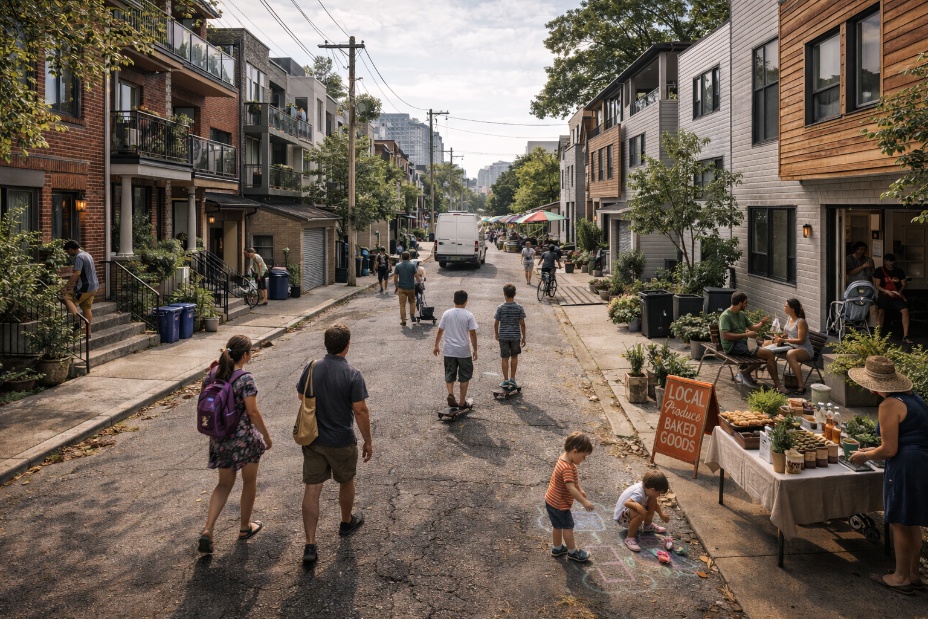
Transition Zones create an opportunity to widen that choice close to main streets and transit. They can also make room for the small businesses, workspaces and shared facilities that support daily life. Planning for those opportunities together is part of the broader case for Transition Zones.
Homes, uses and connections
The same blocks can support housing, local activity and shared services. Explore the drawing to see how those opportunities relate to one another.
An apartment, a townhouse, a shared home and a multiplex can accommodate different needs. A wider range of sizes and layouts gives more households a chance to find something suitable nearby.
Housing and households
Multiplexes, townhouses and small apartment buildings can offer different unit sizes, entrances and relationships to outdoor space. Existing buildings can also be converted or added to. Together, these forms can accommodate people living alone, couples, families, shared households and multigenerational arrangements.
The opportunity extends across tenure and delivery models: rental and ownership housing, co-operatives, non-profit and supportive housing, student housing, seniors’ housing and co-housing. A building’s form does not determine its tenure, and smaller buildings need not serve only one kind of household.
Accessibility deserves attention from the outset. A person who can no longer manage stairs should have a reasonable prospect of finding another home near familiar shops, friends and services. Step-free entrances, elevators and adaptable layouts can help, where they are incorporated into viable designs.
More permissions can make these homes possible. Securing affordable rents, supporting non-market providers and protecting existing renters requires additional measures. Those objectives should be built into the implementation program.
Work, business and everyday contact
Some businesses need the exposure of a main street. Others, including a small studio, shared workspace or low-impact workshop, may work well a short distance away. Live-work space, a corner store or a modest café can add convenience and provide places for people to meet.
These possibilities need to be reflected in the policy and zoning. Their location, size, operating conditions, deliveries and relationship to nearby homes all matter. The objective is to make suitable uses possible where they contribute to the neighbourhood.
Services and infrastructure
Roads, watermains, sewers, transit routes, schools and community facilities represent a substantial public investment. Accommodating more people within reach of that investment can make better use of it and spread the cost of supporting it across a larger population.
The opportunity varies by area. A school with available places and a bus route with capacity present different conditions from a neighbourhood where services are already under pressure. The assessment needs to establish what can be used more effectively, what needs to be upgraded and how those improvements will be funded and delivered.
That is also a reason to plan across several blocks. Housing permissions and capital planning can be considered together, giving the City a clearer basis for anticipating demand than a succession of unrelated applications.
Close to daily needs
More homes near frequent transit give more people the option of making everyday trips without a car. Nearby residents also form part of the customer base that supports main-street businesses.
Housing close to these destinations can make daily routines easier. Safe crossings, comfortable sidewalks and useful connections help turn a short distance on a map into an accessible trip.
A community room, tool-lending space, garden or food-support facility can provide practical help and opportunities for contact. Flexible space allows those activities to respond to local needs over time.
Supporting the change
Bicycle parking, Bike Share facilities, shared mobility and well-located parcel collection can support a neighbourhood with more residents and different travel patterns. Deliveries, waste collection and servicing also need workable arrangements that keep sidewalks and public space usable.
Trees, landscaping and the retention of useful existing buildings should be considered alongside new construction. The value of a Transition Zone lies in what it makes possible for the neighbourhood as a whole, including the people who already live there.
Next / Choosing the areasWhere would this approach work?